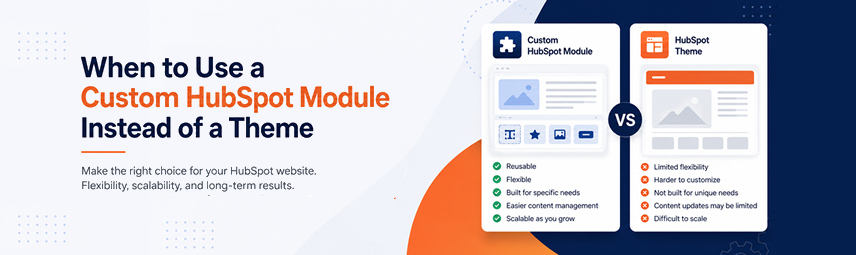
HubSpot themes have made website development significantly easier. They provide pre-built templates, styling options, and reusable layouts that allow businesses to launch websites quickly.
However, as websites grow and marketing requirements evolve, many teams discover that themes alone are not always enough.
A common question we hear is:
"Should we continue customizing our theme, or should we build a custom HubSpot module?"
The answer depends on your goals, content strategy, and long-term maintenance plans.
In this article, we'll explore when a custom HubSpot module becomes the smarter investment.
Understanding the Difference
Before comparing the two approaches, it's important to understand what each one is designed to do.
HubSpot Theme
A theme provides the overall structure and visual foundation of a website.
Themes typically include:
- Page templates
- Global styles
- Navigation layouts
- Typography settings
- Basic content sections
A theme helps ensure visual consistency across your website.
Custom HubSpot Module
A custom module is a reusable component designed for a specific purpose.
Examples include:
- Testimonial sliders
- Pricing comparison tables
- Content tabs
- Multi-step forms
- FAQ accordions
- Team member showcases
- Interactive calculators
Modules can be placed anywhere within HubSpot's drag-and-drop editor and reused across multiple pages.
Use a Theme When You Need a Fast Website Launch
If you're launching a new website and your requirements are relatively standard, a theme is usually the best starting point.
Themes are ideal when:
- You need a website quickly
- Your content structure is straightforward
- You have limited development resources
- Your design requirements closely match available templates
For many small businesses, a quality theme may be all that's needed.
Use Custom Modules When Content Repeats Across Multiple Pages
One of the strongest reasons to create a custom module is content reusability.
Imagine your website contains:
- Feature comparison tables
- Customer testimonials
- Service highlights
- Frequently asked questions
If these sections appear across multiple pages, manually recreating them becomes inefficient.
A custom module allows content editors to add these sections consistently without rebuilding layouts from scratch.
This reduces errors and improves website maintainability.
Use Custom Modules When Marketers Need More Flexibility
Many themes provide fixed layouts that work well initially but become restrictive over time.
Marketing teams often need the ability to:
- Rearrange content sections
- Add new fields
- Display different content variations
- Customize layouts without developer assistance
Custom modules provide flexibility while maintaining design consistency.
Instead of requesting developer support for every change, content teams can manage updates directly within HubSpot.
Use Custom Modules for Unique Business Requirements
Every business eventually encounters requirements that generic themes cannot support.
Examples include:
- Industry-specific calculators
- Interactive product selectors
- Advanced comparison tables
- Dynamic lead generation forms
- Custom integrations
Trying to force these features into an existing theme often leads to technical debt and difficult maintenance.
A dedicated custom module is usually cleaner, faster, and easier to manage.
Use Custom Modules to Improve Scalability
As websites grow, maintaining consistency becomes more challenging.
Without reusable modules, teams often duplicate sections and modify them individually.
Over time this creates:
- Design inconsistencies
- Content duplication
- Higher maintenance costs
- Slower page creation
Custom modules help standardize important website components.
When updates are required, improvements can often be made once and applied everywhere the module is used.
Use Custom Modules to Improve Website Performance
A common misconception is that adding custom functionality always makes a website slower.
In reality, well-built custom modules can improve performance.
Instead of loading unnecessary features from a large theme, custom modules can load only the resources required for a specific component.
Benefits may include:
- Faster page load times
- Reduced JavaScript execution
- Smaller asset sizes
- Better user experience
Performance becomes especially important for high-traffic websites and landing pages focused on conversions.
The Best Approach Is Often Both
Themes and custom modules should not be viewed as competing solutions.
The most successful HubSpot websites typically combine both.
A theme provides:
- Structure
- Branding
- Global design consistency
Custom modules provide:
- Flexibility
- Specialized functionality
- Reusable content components
Together, they create a website that is both scalable and easy to manage.
Final Thoughts
A HubSpot theme is an excellent foundation, but it should not be expected to solve every business challenge.
When your website requires reusable content, specialized functionality, improved flexibility, or long-term scalability, custom HubSpot modules often become the better solution.
Rather than continuously modifying a theme beyond its intended purpose, investing in well-designed modules can provide a cleaner, more maintainable experience for both developers and content teams.
By understanding when to use each approach, businesses can build HubSpot websites that remain efficient, consistent, and adaptable as their needs evolve.