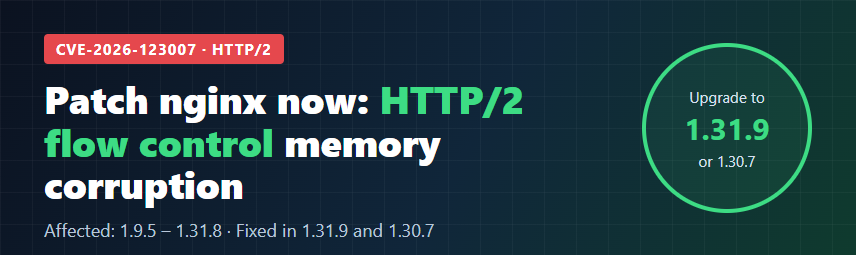
On 18 November 2026 the nginx team released nginx 1.31.9 (mainline) and nginx 1.30.7 (stable). These releases fix ten security issues. The one rated major that affects the most servers is CVE-2026-123007, a memory corruption bug in HTTP/2 flow control. If your site serves HTTP/2 through nginx, plan to update now.
This guide explains what the bug is, who is at risk, how to check your server, and how to fix it step by step.
What is CVE-2026-123007?
HTTP/2 uses a "flow control window" to limit how much data each side may send before it waits. The nginx changelog describes the bug like this:
"a flow control window overflow in HTTP/2 might allow an attacker to cause a segmentation fault in a worker process, or might have potential other impact (CVE-2026-123007)."
The CVE record published by F5 (the company behind nginx) adds that, when nginx processes certain undisclosed traffic, the flow control window can go past its allowed limit. This can cause a heap buffer overflow, usually followed by a crash (segmentation fault) of the nginx worker process. The weakness types listed are CWE-191 (Integer Underflow) and CWE-787 (Out-of-bounds Write).
Severity
- nginx.org rating: major
- CVSS v3.1: 8.1 (High) —
CVSS:3.1/AV:N/AC:H/PR:N/UI:N/S:U/C:H/I:H/A:H - CVSS v4.0: 9.2 (Critical) —
CVSS:4.0/AV:N/AC:H/AT:N/PR:N/UI:N/VC:H/VI:H/VA:H/SC:N/SI:N/SA:N
In plain words: an attacker can reach it over the network, needs no login and no help from a user, but the attack is not simple to carry out ("attack complexity: high"). The most likely result is crashed worker processes (a denial of service). Because it is an out-of-bounds write, more serious impact cannot be ruled out.
Affected and fixed versions
| Branch | Vulnerable | Fixed in |
|---|---|---|
| Mainline | 1.31.0 – 1.31.8 | 1.31.9 |
| Stable | 1.30.0 – 1.30.6 | 1.30.7 |
| Older releases | 1.9.5 – 1.29.x | No fix; upgrade to 1.30.7 or 1.31.9 |
nginx.org lists the vulnerable range as 1.9.5 – 1.31.8. Version 1.9.5 is the release that added HTTP/2 support, so every nginx version with HTTP/2 up to 1.31.8 is affected. NGINX Plus is affected too; if you use it, follow F5's advisory for the fixed Plus releases.
Who is at risk?
You are at risk if both of these are true:
- Your nginx version is between 1.9.5 and 1.31.8 (and your OS vendor has not shipped a patched package), and
- HTTP/2 is enabled in your configuration, with
http2 on;(nginx 1.25.1 and later) or the olderlisten 443 ssl http2;style.
That covers most public HTTPS sites and reverse proxies running nginx, since HTTP/2 is usually turned on for performance. Servers that only speak HTTP/1.1 do not use the vulnerable code path.
How to check if you are affected
1. Check your nginx version
nginx -v
# Example output: nginx version: nginx/1.30.6
Any version from 1.9.5 to 1.31.8 is vulnerable, unless your distribution has backported the fix (see the note below).
2. Check that HTTP/2 support is built in
nginx -V 2>&1 | grep -o with-http_v2_moduleIf this prints with-http_v2_module, your build can serve HTTP/2.
3. Check whether HTTP/2 is enabled in your config
sudo nginx -T 2>/dev/null | grep -n 'http2'Lines such as http2 on; or listen 443 ssl http2; mean HTTP/2 is enabled and you should treat the server as affected.
4. Confirm from outside
curl -sI --http2 https://your-domain.example | head -n 1
# "HTTP/2 200" means the server answers over HTTP/2
Note about distribution packages: Debian, Ubuntu, RHEL and other distributions often backport security fixes without changing the upstream version number. If you use your distribution's nginx package, check its security tracker or advisory for CVE-2026-123007 to see if your installed package already contains the fix.
How to fix it
Option 1 (recommended): upgrade nginx
Upgrade to 1.31.9 (mainline) or 1.30.7 (stable) or later. First, test and back up your current configuration:
sudo nginx -t
sudo cp -a /etc/nginx /etc/nginx.bak-$(date +%F)
Debian / Ubuntu (nginx.org repository or a distribution package with the fix):
sudo apt update
sudo apt install --only-upgrade nginx
nginx -v
RHEL / Rocky / AlmaLinux / Fedora:
sudo dnf upgrade nginx
nginx -v
Then check the configuration and restart nginx so that every worker runs the new binary:
sudo nginx -t && sudo systemctl restart nginx
systemctl status nginx --no-pager
Built from source: download the fixed release from nginx.org/en/download.html, verify its PGP signature, and rebuild using the same ./configure arguments that nginx -V shows for your current build.
Docker: move to an image built on nginx 1.31.9 or 1.30.7 or later, pull it, and recreate your containers. Restarting an old container does not update nginx.
Option 2 (temporary workaround): turn off HTTP/2
If you cannot upgrade right away, you can stop using the vulnerable code by disabling HTTP/2 until you patch. This is our suggestion based on the advisory saying the issue affects configurations that use HTTP/2; it is not an official fix, and clients will fall back to HTTP/1.1, which may be a little slower.
# nginx 1.25.1 and later: change every "http2 on;" to
http2 off;

# Older style: remove "http2" from every listen line
# before:  listen 443 ssl http2;
# after:   listen 443 ssl;
A http2 on; inside a server block overrides http2 off; in the http block, so change every occurrence. Then reload and re-run the check from step 3 above until it finds nothing that enables HTTP/2:
sudo nginx -t && sudo systemctl reload nginx
curl -sI --http2 https://your-domain.example | head -n 1
# should now show HTTP/1.1
Upgrade as soon as possible and turn HTTP/2 back on afterwards.
How to verify the fix
- Version check:
nginx -vshould show 1.31.9, 1.30.7 or later (or your distribution's patched package version). - Running processes use the new binary:
ps -o pid,lstart,cmd -C nginxshould show start times after your upgrade. If they are older, restart nginx. - Config is valid:
sudo nginx -treports "syntax is ok" and "test is successful". - Site still works:
curl -sI --http2 https://your-domain.example | head -n 1returns a 2xx or 3xx status (andHTTP/2again if you re-enabled it). - No crashes: watch the error log for worker crashes:
sudo grep -i "signal 11" /var/log/nginx/error.log.
Other issues fixed in the same release
nginx 1.31.9 and 1.30.7 also fix nine more issues, including a use-after-free in the resolver (CVE-2026-123634), use-after-free bugs in HTTP/2 (CVE-2026-123633) and HTTP/3 (CVE-2026-121810), an infinite loop when reading request bodies over TLS 1.3 (CVE-2026-118899, major), and a use-after-free in the mail proxy module (CVE-2026-113425, major). One upgrade fixes all of them, so even if you do not use HTTP/2, upgrading is still the right move.
Summary
- CVE: CVE-2026-123007, memory corruption in HTTP/2 flow control (major; CVSS 3.1 score 8.1).
- Affected: nginx 1.9.5 – 1.31.8 with HTTP/2 enabled.
- Fixed: nginx 1.31.9 (mainline) and 1.30.7 (stable).
- Do now: upgrade and restart. If you cannot, disable HTTP/2 for now.